
Federal Complaint Filed to Secure the Grid
COMPLAINT AND PETITION
Submitted to FERC on March 9, 2026
Introduction:
The Center for Security Policy (CSP) is a non-profit, non-partisan 501(c)(3) organization whose mission is to provide uncompromised national security analysis and solutions to keep Americans safer. The Secure the Grid (STG) Coalition is a group of national security, energy policy and technical experts, focused on the security of the electric grid. Neither the CSP nor the STG Coalition receive any funding from governments, foreign sources, or industries and companies that can profit from our policy recommendations. We exist purely to support the public interest and national security of the United States. The members of the Secure the Grid Coalition also are electric utility ratepayers and would be adversely impacted by a failure of the Bulk Power System. Ground induced current (“GIC”) from both solar weather and E3 HEMP threaten our electric power grid.
We are filing this complaint under 16 U.S. Code § 824o(d)(5)[1] because:
- The current NERC standard for GIC protection[2] is inadequate.
- The electric utility industry must be incentivized by cost recovery to protect the grid from GIC to the Department of Energy recommendations,[3] Congressional EMP Commission recommendations[4], and the International Electrotechnical Commission (IEC) Standard[5] and to avoid exceeding the IEEE 519 Standard[6] due to GIC induced harmonics which is costing the U.S. economy billions of dollars each year.
Request for Investigation:
We request that the Commission issue a public notice of this Complaint pursuant to 18 CFR § 385.206(d), investigate this Complaint and issue an appropriate order to the Electric Reliability Organization (“ERO”) to harden the bulk power system from GIC damage caused by GMD and E3 HEMP by specifying that rate recovery is approved for assessing and hardening the system to 85 V/km.
Background:
As shown in Figure 1, the current NERC standard does not protect the electric grid from the GIC threat:
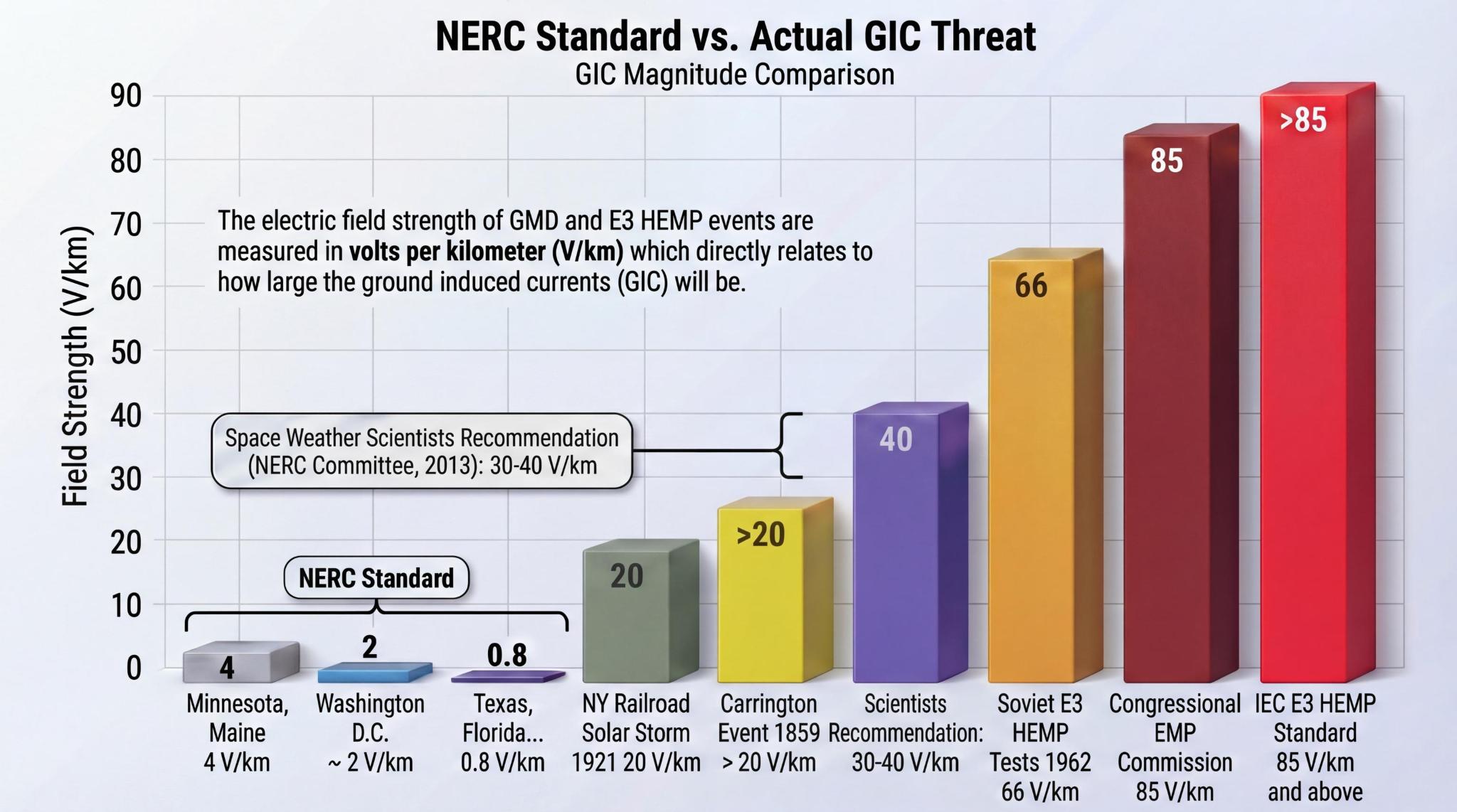
Figure 1
Credible studies conclude that our electric grid suffers an estimated $10 billion every year due to GIC triggered harmonic anomalies in the electric grid.[7] [8] [9]
For a one-time investment of approximately $4 billion, the U.S. could not only stop this $10 billion annual economic loss but would also permanently protect the electric grid from the GIC hazards associated with severe space weather and High-Altitude Electromagnetic Pulse (HEMP).[10]
NERC TPL-007-4 is a consensus-based document – the lowest common denominator to achieve sufficient votes by the regulated industry. The standard does not protect against Ground Induced Currents (GIC), the half-cycle saturation of transformers and the resulting harmonics which routinely damage equipment in the Bulk Power System. [11]
On May 16, 2013, the Federal Energy Regulatory Commission (FERC) issued Order No. 779, directing the North American Electric Reliability Corporation (NERC) to develop mandatory reliability standards to mitigate the risks of geomagnetic disturbances (GMD) on the Bulk-Power System. However, NERC’s “model” (written by the industry) purposely excluded the 1921 storm which produced 20 V/km.[12] The standard was intended to address a one in 100-year GMD event but did not include the largest solar storm in the 100-year period (the 1921 storm). Thus, the NERC standard failed to address one in 100-year GMD event.
GIC blocking devices attached to the neutral of a transformer exist and have been proven and validated both in the United States as well as internationally.[13]
The Center for Security Policy and the Secure the Grid Coalition have submitted several research papers to the Department of Energy on the issue of GIC protection for the electric grid and now submits these to the Commission for the record.[14] [15] [16]
National reliance on large “data centers” to power Artificial Intelligence (AI) tools is increasing.[17] Both the U.S. Economy and the Defense Department will require reliable power to Data Centers that could be interrupted by GIC events. On March 1, 2026, The Wall Street Journal reported: “Data centers are equipped with technologies that monitor for disturbances on the grid that could cause a power outage and affect operations. When disturbances occur, many data centers automatically shift to backup supplies, severing their grid connections until power quality stabilizes.”[18] The sudden and unexpected loss of thousands of megawatts of data center demand during a GIC event will further stress our unprotected grid.
On May 7, 2025, the Nuclear Regulatory Commission (NRC) published in the federal register[19] an extremely consequential decision with respect to the health, safety, and welfare of the American people and the environment of the continental United States. After more than fourteen years of deliberation, NRC denied an important Petition for Rulemaking submitted in February 2011, by the Foundation for Resilient Societies[20]. This Petition, docketed as PRM 50-96,[21] warned of the potentially catastrophic consequences associated with the long-term loss of offsite power for nuclear power plants, a realistic scenario given the vulnerability of America’s electric grid to ground induced currents (“GIC”) as a result of geomagnetic disturbances (GMDs) produced by the sun and intentional high-altitude electromagnetic pulse (E3 HEMP) attack by enemies of the United States.
Were a major solar storm to blackout the nation’s grid for an extended period, numerous nuclear sites could be at risk of this scenario if their emergency diesel generators fail or run out of fuel. Thus, NERC’s inadequate TPL-007-4 puts the United States at risk of a GIC induced nuclear disaster.[22]
We point out to the Commission that utility “Operating Procedures” cannot prevent GIC from entering an operating grid and are dangerously insufficient to protect the system from severe GIC. “Operating procedures” – including VAR supply and load shedding – will ensure grid components are exposed to more severe GIC and harmonics over a longer duration prior to failure, putting critical components at greater risk of permanent damage. The AC circuit breakers these procedures rely on are not designed to operate with GIC across them. As high-voltage circuit breakers begin to trip intentionally due to operating procedures or automatically due to effects of voltage collapse, there is considerable uncertainty regarding their ability to interrupt significant levels of GIC and harmonic currents. This is a dangerous misapplication and has never been tested. Failure to interrupt would lead to catastrophic failure in the arcing chamber which contains over 100 pounds of SF6 gas – the world’s most toxic greenhouse gas – releasing it into the environment. Load shedding increases this risk to high-voltage breakers even further, as it lowers the AC current across them which enhances the GIC bias. Each destroyed circuit breaker means a prolonged blackout for large sections of the grid. Self-induced “load shedding procedures” to shut the entire grid down, will themselves result in extremely prolonged blackouts. Nevertheless, industry lobbyists consistently placate lawmakers and executive branch officials with these “operating procedures” and “load shedding” arguments, but in reality, this is “a great experiment” that has never been conducted and one that would cause catastrophic harm to the grid and to the American people.
Finally, we bring to the Commission’s attention Exhibit K, “Appendix II – Myths Vs Facts on GICs from GMD/HEMP.” There is a series of myths that the self-regulator (NERC) and the utility industry propagate to avoid legislative or administrative action to protect the grid. This is a simple problem with simple solutions. The industry has a long history of trying to complicate the simple to avoid regulation. We implore the Commission not to fall into the industry’s “complication trap.”
Conclusion:
It is in the public interest as well as in the national security interest of the United States to assess the vulnerability of transformers and the power grid to the established international standard of 85 V/km and to protect the vulnerable transformers with proven and tested GIC blocking technology.
Relief Sought:
The Federal Energy Regulatory Commission should direct the North American Electric Reliability Corporation (NERC) to conduct a comprehensive survey of all registered entities in the Bulk Power System:
- Each registered entity shall, no later than a date determined by the Commission, conduct a technical assessment of all covered equipment to determine vulnerability to GICs. The assessment shall:
-
- Utilize the waveform in Figure A.5 of IEC 61000-2-9, Edition 2.0 (2025-05), modeling a peak magnetic field strength of 20,000 nT, or the corresponding waveform in Figure 9, modeling a peak electric field of 85 V/km.
- Assume transformers are fully loaded during GIC exposure.
- Account for transformer age and condition using ANSI/IEEE Standard C57.110 and IEEE Standard C57.91.
- Identify susceptibility to half-cycle saturation, GIC-induced harmonics, reactive power consumption, hot spot generation, and insulation degradation.
- The Commission should provide cost recovery for assessment and GIC protection to 85 V/km.
Respectfully submitted,
For Government Website Copy: CLICK HERE.
For Full PDF with Exhibits: CLICK HERE
Attachments:
- Complaint (PDF)
- 18 CFR § 385.206 Compliance Information
- Draft Notice
- Exhibit A: NERC TPL-007-4 – Transmission System Planned Performance for Geomagnetic Disturbance Events. October 1, 2020.
- Exhibit B: Abstract from “IEEE Standard for Harmonic Control in Electric Power Systems,” in IEEE Std 519-2022 (Revision of IEEE Std 519-2014), vol., no., pp.1-31, August 5, 2022. (Entire standard incorporated by reference.)
- Exhibit C: “Physical Characteristics of HEMP Waveform Benchmarks for Use in Assessing Susceptibilities of the Power Grid, Electrical Infrastructures, and Other Critical Infrastructure to HEMP Insults” U.S. Department of Energy. January 11, 2021.
- Exhibit D: “Recommended E3 HEMP Heave Electric Field Waveform for the Critical Infrastructures.” Commission to Assess the Threat to the United States from Electromagnetic Pulse (EMP) Attack. July 2017.
- Exhibit E: Abstract from “Standard late-time HEMP waveform, International Electrotechnical Commission IEC 61000-2-9, Edition 2.0, 2025-05 (Entire standard incorporated by reference).
- Exhibit F: U.S. Senate Committee on Homeland Security and Government Affairs, Statement by Dr. Justin Kasper. February 27, 2019.
- Exhibit G “Electrical Claims and Space Weather: Measuring the visible effects of an invisible force.” Zurich Risk Engineering, Lockheed Martin Advanced Technology Center. June 2015.
- Exhibit H: “Assessing the impact of space weather on the electric power grid based on insurance claims for industrial electrical equipment.” C. J. Schrijver, R. Dobbins, W. Murtagh, and S. M. Petrinec. July 8, 2014.
- Exhibit I: “Estimating the Cost of Protecting the U.S. Electric Grid from Electromagnetic Pulse.” Foundation for Resilient Societies. September 2020. And: “Protecting U.S. Electric Grid Communications from Electromagnetic Pulse.” Foundation for Resilient Societies. May 2020.
- Exhibit J: “Protecting the grid from solar storms.” Western Area Power Administration. April 2023.
- Exhibit K: “Speed to Power on a Firm Foundation: Overcoming Dangerous Assumptions That Put America’s Future at Risk.” Center for Security Policy. November 2025.
- Exhibit L: Comments of Secure the Grid Coalition on DOE “Speed to Power” RFI (2025-18058). Secure the Grid Coalition. November 21, 2025.
- Exhibit M: Addendum on China, re: Secure the Grid Coalition’s DOE “Speed to Power” RFI Response. Secure the Grid Coalition. January 12, 2026.
- Exhibit N: Executive Order 14318. “Accelerating Federal Permitting of Data Center Infrastructure.” July 23, 2025.
- Exhibit O; “A New Threat to Power Grids: Data Centers Unplugging at Once: Dozens of data centers abruptly dropped off the power grid in recent Virginia incidents, forcing operators to take emergency action.” Wall Street Journal. March 1, 2026.
- Exhibit P: “Electric Reliability Standards for Solar Geomagnetic Disturbances.” Comments submitted to the Federal Energy Regulatory Commission by Thomas S. Popik, George H. Baker, and William R. Harris. June 2017
- Exhibit Q: “Benchmark Geomagnetic Disturbance Event Description” Project 2013-03. GMD Mitigation Standard Drafting Team. NERC. May 12, 2016.
Footnotes:
[1] “The Commission, upon its own motion or upon complaint, may order the Electric Reliability Organization to submit to the Commission a proposed reliability standard or a modification to a reliability standard that addresses a specific matter if the Commission considers such a new or modified reliability standard appropriate to carry out this section.” [Emphasis added.]
[2] NERC TPL-007-4 – Transmission System Planned Performance for Geomagnetic Disturbance Events. October 1, 2020. (Attached hereto as Exhibit A.)
[3] “Physical Characteristics of HEMP Waveform Benchmarks for Use in Assessing Susceptibilities of the Power Grid, Electrical Infrastructures, and Other Critical Infrastructure to HEMP Insults” U.S. Department of Energy. January 11, 2021. (Attached hereto as Exhibit C.)
[4] “Recommended E3 HEMP Heave Electric Field Waveform for the Critical Infrastructures.” Commission to Assess the Threat to the United States from Electromagnetic Pulse (EMP) Attack. July 2017. (Attached hereto as Exhibit D.)
[5] “Standard late-time HEMP waveform, International Electrotechnical Commission IEC 61000-2-9, Edition 2.0, 2025-05 (Abstract attached hereto as Exhibit E, entire standard incorporated by reference.)
[6] “IEEE Standard for Harmonic Control in Electric Power Systems,” in IEEE Std 519-2022 (Revision of IEEE Std 519-2014), vol., no., pp.1-31, August 5, 2022. (Abstract attached hereto as Exhibit B. entire standard incorporated by reference)
[7] U.S. Senate Committee on Homeland Security and Government Affairs, Statement by Dr. Justin Kasper. February 27, 2019. (Attached hereto as Exhibit F.)
[8] “Electrical Claims and Space Weather: Measuring the visible effects of an invisible force.” Zurich Risk Engineering, Lockheed Martin Advanced Technology Center. June 2015. (Attached hereto as Exhibit G.)
[9] “Assessing the impact of space weather on the electric power grid based on insurance claims for industrial electrical equipment.” C. J. Schrijver, R. Dobbins, W. Murtagh, and S. M. Petrinec. July 8, 2014. (Attached hereto as Exhibit H.)
[10] See page 63: “Estimating the Cost of Protecting the U.S. Electric Grid from Electromagnetic Pulse.” Foundation for Resilient Societies. September 2020.
[11] NERC TPL-007-4 “Transmission System Planned Performance for Geomagnetic Disturbance Events.” (Attached hereto as Exhibit A.)
[12] “Benchmark Geomagnetic Disturbance Event Description” Project 2013-03. GMD Mitigation Standard Drafting Team. May 12, 2016. (Attached hereto as Exhibit Q.)
[13] “Protecting the grid from solar storms.” Western Area Power Administration. April 2023. . (Attached hereto as Exhibit J.)
[14] “Speed to Power on a Firm Foundation: Overcoming Dangerous Assumptions That Put America’s Future at Risk.” Center for Security Policy. November 2025. (Attached hereto as Exhibit K.)
[15] Comments of Secure the Grid Coalition on DOE “Speed to Power” RFI (2025-18058). Secure the Grid Coalition. November 21, 2025. (Attached hereto as Exhibit L.)
[16] Addendum on China, re: Secure the Grid Coalition’s DOE “Speed to Power” RFI Response. Secure the Grid Coalition. January 12, 2026. (Attached hereto as Exhibit M.)
[17] Executive Order 14318. “Accelerating Federal Permitting of Data Center Infrastructure.” July 23, 2025. (Attached hereto as Exhibit N.)
[18] “A New Threat to Power Grids: Data Centers Unplugging at Once: Dozens of data centers abruptly dropped off the power grid in recent Virginia incidents, forcing operators to take emergency action.” Wall Street Journal. March 1, 2026. Attached hereto as Exhibit O.)
[19] NRC Ruling, “Long-Term Cooling and Unattended Water Makeup of Spent Fuel Pools,” https://www.federalregister.gov/documents/2025/05/07/2025-07899/long-term-cooling-and-unattended-water-makeup-of-spent-fuel-pools (Incorporated by reference).
[20] Homepage: Foundation for Resilient Societies, https://www.resilientsocieties.org/
[21] Foundation for Resilient Societies, In the Matter of a Proposed Rulemaking Regarding Amendment of 10 CFR Part 50, “Domestic Licensing of Production and Utilization Facilities” https://www.resilientsocieties.org/uploads/5/4/0/0/54008795/petition_for_rulemaking_resilient_societies_docketed.pdf (Incorporated by reference).
[22] “Electric Reliability Standards for Solar Geomagnetic Disturbances.” Comments submitted to the Federal Energy Regulatory Commission by Thomas S. Popik, George H. Baker, and William R. Harris. June 2017. (Attached hereto as Exhibit P.)
SUPPORT US!!
Your tax-deductible donation can be made here: (Select “Secure the Grid Coalition” under Project Designation):