Don't let the lights go out in America.

Grid Security Explainer

The InvisibleCurrent

How geomagnetically induced currents—and the harmonics they create—threaten the equipment holding America's grid steady.

Watch the film Watch on YouTube  •  Sources

The Story in Plain Language

What the film explains

Three ideas a policymaker—or any American—should understand after watching.

1

Current Enters

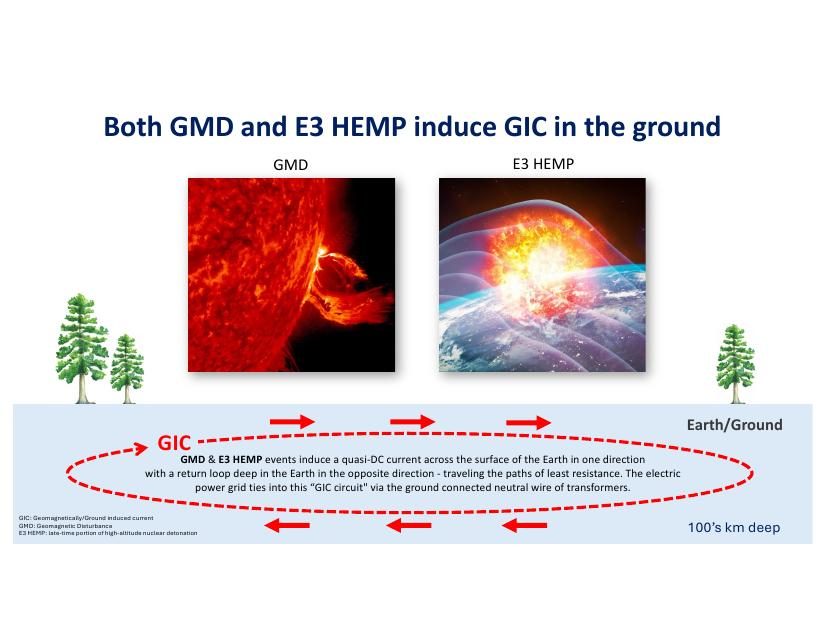
Solar storms—and the E3 pulse of a high-altitude nuclear detonation—drive quasi-DC currents through the ground. That current, GIC, enters high-voltage transformers through their grounded neutral wires.

2

The Core Saturates

Even a few amps can push a large transformer into half-cycle saturation—within about one second. The transformer keeps running, but it begins distorting the power flowing through it.

3

Harmonics Spread

That distortion—harmonics—propagates and amplifies as it travels toward the customer, generating heat, tripping protective relays and VAR support, degrading equipment, and damaging transformers, generators, sensitive equipment, and breakers attempting to open.

Solar Weather or E3 HEMP GIC in the Ground Enters the Grid Half-Cycle Saturation Reactive Power Consumed Harmonics Tripping, Degradation, Damage & Economic Loss
Why This Matters

Harmonics are the primary damage mechanism

The threat is often described as transformers overheating. That misses the larger problem: a saturated transformer becomes an active threat to everything around it, injecting distorted current into the grid long before any hotspot forms.

Step 1

GIC enters the grid

Through the grounded neutral wires of large power transformers—the grid's open door to ground currents.

Step 2

Half-cycle saturation

The core saturates within ~1 second. Roughly 6,000 U.S. large power transformers are of designs that saturate at 5 amps per phase or less.

Step 3

Harmonics injected & amplified

Distortion grows as it travels toward load—measured rise from ~1% to ~32% through a step-down transformer.

Step 4

Tripping, degradation, damage, economic loss

Relays and VAR support trip unexpectedly; generators, transformers, and breakers are stressed; equipment ages—an estimated $10 billion in U.S. losses each year.

“Misconception in the electric power industry—paying more attention to thermal effects in transformers and not to the true issue of increased VAR demand and effect of harmonics on power system components.”
CIGRE — “Susceptibility of TVA's 500 kV Fleet of Power Transformers to Effects of GIC,” 2017

The Evidence

Measured, not modeled

Insurance records, live-grid injection testing, and four decades of storm history all point to the same causal chain—operating today, not just in a worst-case future.

Live-Grid Testing — 1989

8.3 A

per phase—every large design saturated

Even the largest transformers saturate at low current

Minnesota Power (EPRI RP1770-1) injected DC into the neutrals of three large transformer designs—200+ MVA units on their own power system. Every design began saturating and generating harmonics at the lowest level injected: 8.3 amps per phase (25 amps on the neutral). EPRI's conclusion: geomagnetic disturbances over an entire continent “turn nearly every transformer… into harmonic current generators.”

These tests measured only the high-voltage side—where harmonics are smallest.

EPRI RP1770-1 / Minnesota Power, 1989

Live-Grid Testing — 2012

1% → 32%

harmonic amplification toward load

The amplification the 1989 tests couldn't see

DTRA and Idaho National Laboratory injected DC into transformer neutrals on a live 138 kV grid. Saturation began within one second, and less than 5 amps per phase produced secondary-side distortion beyond the IEEE 519 limit—because harmonics amplify as they travel through step-down transformers into lower voltage, measured rising from ~1% to ~32%. Testing was stopped at 40 amps over concern of harmonic damage to the power system.

DTRA/INL live-grid experiment, 2012

The Insurance Record

11,242

claims analyzed, 2000–2010

Routine space weather is already costing us

Zurich, Lockheed Martin, and NOAA analyzed a decade of North American industrial-equipment insurance claims. Claim rates ran roughly 20% higher on the most geomagnetically active days—evidence that GIC-driven power-quality disturbances reach all the way into customer equipment. The Zurich reports point to exactly the amplification mechanism measured at INL as the explanation for an estimated $10 billion in annual U.S. economic loss.

Schrijver et al., Space Weather Journal, 2014; Zurich, “Electrical Claims and Space Weather,” 2015

The Storm Record

92 sec

to collapse a provincial grid

History keeps repeating the chain

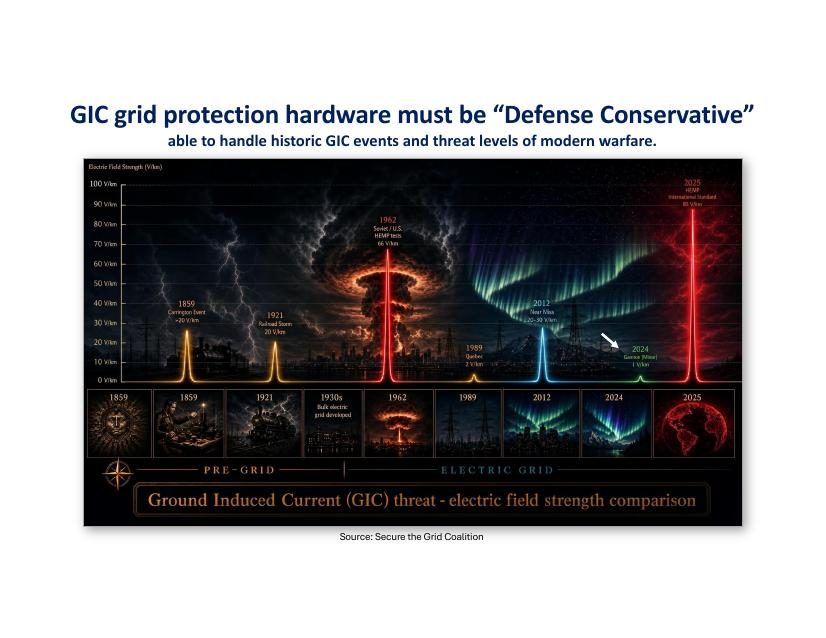
March 1989: harmonics from a moderate 2 V/km storm tripped VAR support and collapsed Québec's grid in 92 seconds, leaving six million people in the dark. The 2003 storms damaged transformers as far from the poles as South Africa. May 2024: GIC from a smaller 1 V/km storm again drove “high levels of harmonic currents on the system” that unexpectedly tripped VAR supply on the U.S. grid.

NERC 1989 disturbance analysis; Gaunt & Coetzee (Eskom), 2007; 2024 Gannon storm reports

Hear It From the Lab

Inside the Idaho National Laboratory testing

E1 filters exacerbated GIC-related harmonics by 50%. Proper sequence: GIC protection must be addressed prior to E1 protection.

INL's infrastructure security lead walks through the live-grid GMD testing referenced above—the measurements behind this page. Watch on YouTube

<1 secto core saturation on the live grid
<5 Aper phase exceeded IEEE 519 limits
1→32%distortion amplified toward load
40 Atest halted to protect the grid
“A filter designed to protect against one challenge… that exacerbates the problem due to geomagnetic disturbances.”
Scott McBride — Infrastructure Security Manager, INL

Downloadable Briefing

The full technical briefing

The 36-page deck behind this page—prepared for policymakers and technical staff.

36 pages · PDF · 12 MB

Prepared for public education—not a product advertisement. Secure the Grid Coalition exists solely for the public benefit and has no financial ties with any company that could profit or benefit from the recommendations.

Further Reading Read the accompanying article and review the full source list

The Planning Gap

When observation exceeds the model

Grid planning in the U.S. is built around the NERC TPL-007-4 benchmark storm. But measured and reconstructed events—including storms that have already happened—point to geoelectric fields substantially beyond what the benchmark assumes.

The NERC standard does not factor in GIC-induced harmonic impact—the mechanism that knocks down the power grid with relatively low GIC.

The observational record reinforces the gap: USGS reconstructions of the May 1921 storm (Love et al.) indicate geoelectric fields well above the benchmark across large regions, the 2003 storms damaged transformers at low geomagnetic latitudes where models placed little risk, and INL's live-grid measurements show damaging harmonics beginning at currents far below what a benchmark-level event would drive.

A note on the NERC standard

The NERC TPL-007-4 standard is not a GIC protection standard. It is a self-regulatory standard based on modeling focused on “thermal” damage and is explicitly “Geomagnetic Disturbance (GMD).” It does not consider the most severe GIC impact—harmonics—nor the age of the U.S. transformer fleet, large GMD events in recent history, or E3 HEMP. It further scales down the field strength to levels that require no GIC protection hardware to be installed.

Blocking technology developed & validated with EPRI · DOE · INL · TVA · WAPA · ATC · DTRA · ORNL · ABB

The Direct Solution

Break the chain at its first link

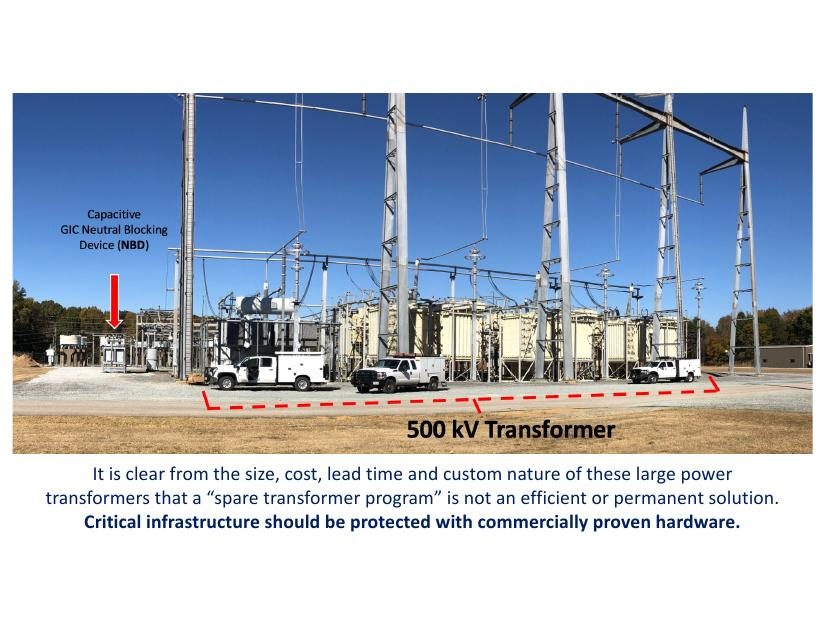
A capacitive neutral blocking device is a capacitor placed in the transformer's neutral-to-ground connection. It blocks quasi-DC ground current while maintaining the AC ground the transformer needs. No GIC in—no saturation, no harmonics, no VAR collapse. The chain never starts.

Blocking GIC at the point of entry

CLEAN AC POWER TRANSFORMER GIC BLOCKER GIC (BLOCKED)

Each device blocks GIC at its point of entry, removes one of the grid's low-resistance paths, and lowers total network GIC—so every installation also improves conditions for its neighbors.

In the field: a SolidGround™ capacitive neutral blocking system installed beside a typical large high-voltage transformer. Click to enlarge.

Built with the industry, proven on the grid

Developed and validated in collaboration with EPRI, DOE, WAPA, TVA, ATC, ABB, INL, DTRA, and ORNL—with more than a decade of operating history on the U.S. grid and a clean record blocking GIC without disrupting normal operations.

Working even in quiet years

On American Transmission Company's system, protected circuits logged 33 blocking operations during 2015–2017—a period of declining solar activity in a comparatively weak cycle. Devices are triggered by elevated GIC levels an average of 15–20 times per year even in such quiet conditions, and activated several dozen times during the May 2024 Gannon storm.

Engineered for the grid it protects

The device maintains the AC ground, operates automatically in milliseconds, and is compatible with distance-relay protection schemes. Ferroresonance risk is eliminated through proper system design—questions the EPRI-guided development program addressed directly.

Protects more than the transformer

Blocking GIC also protects high-voltage circuit breakers from opening against combined GIC and harmonic currents—the failure mode that turns a blackout into a months-long outage.

Four decades of consistent findings

1983

“A capacitor in the neutral of transformers was determined to be the most effective and practical blocking device.” EPRI EL-3295, Project 1770-1

1992

“Inserting blocking devices in the neutral… most logical and effective means of preventing GIC flow… capacitors is the best option.” EPRI TR-100450

2017

“Installation of blocking devices… will significantly reduce the probability of damage from solar storms and… EMP E3.” Report to the Congressional EMP Commission

2019

“Capacitors in the neutral… effective means of blocking the flow of GIC.” EPRI 3002014979, HEMP Mitigation Strategies

2023

“Most neutral grounding transformers of 220kV and above substations in China are mostly considered to install capacitor DC blocking devices.” North China Electric Power University — China is already installing them

Sequence matters: block GIC before installing E1 filters

In INL's 2012 live-grid tests, GIC-induced harmonics measured roughly 50% higher with an EMP E1 filter in the circuit than without it. E1 filters—already installed at many data centers, hospitals, and critical defense facilities—protect against one threat while making the harmonics problem worse.

Protection should be sequenced accordingly: address GIC blocking first, then layer E1 protection on top.

Scott McBride, Idaho National Laboratory — Dupont Summit, 2013

The Economic Case

The math is not close

The losses are not hypothetical—they accrue every year in ordinary space weather. The cost of stopping them is a fraction of a single year's damage.

$10B

Every Year, Today

Estimated annual U.S. economic loss from harmonics driven by routine, low-level GIC activity—ordinary solar weather, not rare superstorms.

Dr. Justin Kasper, U.S. Senate testimony, 2019; Zurich claims analysis

$0.62.6T

One Extreme Event

Lloyd's of London's estimate for a Carrington-class storm striking the North American grid—counting only lost load (meaning only lost utilities' revenues), excluding equipment damage.

Lloyd's, “Solar Storm Risk to the North American Electric Grid,” 2013

~$4B

To Protect the Fleet, Once

Estimated one-time cost to install neutral blocking devices at the ~6,000 highest-risk large power transformers on the U.S. grid.

Scott McBride, INL, U.S. Senate testimony, 2018

The entire E3/GMD fix is less than 2% of the EMP protection bill

The Foundation for Resilient Societies priced full EMP protection for the U.S. grid: $251 billion for E1 hardening versus $4.1 billion for the neutral ground blocking devices that address E3 and GMD. In their words: E3 and GMD protection should be prioritized because it defends large power transformers—expensive assets with long lead times—and GMD is a natural phenomenon that cannot be deterred.

500×

the value at risk versus the cost of E3/GMD hardening—by the Foundation's own conservative assessment.“Estimating the Cost of Protecting the U.S. Electric Grid from Electromagnetic Pulse,” Foundation for Resilient Societies, September 2020, p. 63

Put simply: a one-time investment of roughly $4 billion addresses a problem that costs an estimated $10 billion every year—and stands between the grid and a trillion-dollar event that space weather statistics say is a matter of when, not if.

Compare Every Approach

Only capacitive neutral blocking completely interrupts the causal chain

GIC Enters Grid Half-Cycle Saturation Harmonics

Bottom Line — Real-World Comparisons

Comparison of GIC mitigation approaches across four criteria
Approach Prevents GIC entry? Stops harmonics at source? Field maturity Protects existing fleet?
Capacitive Neutral BlockingThe Complete Fix Yes (complete) Yes High (multi-year ops) Yes
Neutral Resistors Partial Partial Medium Yes
Series Capacitors On protected lines Partial / redistributes High (but costly) Partial
Operating Procedures No No High No
GIC-Resistant Transformers No Partial Medium (new units) No

Secure the Grid Coalition analysis — full source table in the PDF below.

Download the Comparison Table (PDF)

Common Questions

Fair questions, straight answers

Why hasn't the grid already been protected?

Because the industry's own planning standard doesn't require it. NERC TPL-007-4 models a benchmark storm scaled to levels that call for no protection hardware—and consensus standards move at the speed of broad agreement. Meanwhile, the hardware exists and has been recommended in EPRI research since 1983. A 2016 Department of Energy resilience meeting put it plainly: transformer neutral blocking is a “high value quick fix”—“low hanging fruit.”

Doesn't a transformer need its ground connection?

Yes—and it keeps it. A capacitor passes AC ground current normally; it blocks only the quasi-DC ground induced current. The AC safety ground is maintained at all times, and the device design includes automatic protective bypass that restores a direct ground connection if needed.

What about ferroresonance and protective relays?

Both were addressed directly in the EPRI-guided development program. The devices are compatible with distance-relay protection schemes, and ferroresonance risk is eliminated through proper system design—one reason development involved EPRI, DOE, WAPA, TVA, and ATC from the start.

Is this proven, or experimental?

Proven. The technology has more than a decade of operating history on the U.S. grid with a clean record—triggered by elevated GIC levels an average of 15–20 times per year even in quiet solar conditions, and several dozen times during the May 2024 Gannon storm. Validation involved ATC, ABB, DOE, INL, DTRA, ORNL, EPRI, TVA, and WAPA, with device deployments in Wisconsin, Tennessee, North Dakota, and internationally.

Whose decision is it to install protection?

Utilities own and operate the equipment, but they build to the standards regulators set—and today's standards don't require GIC protection. That changes when policymakers and the public ask for it, which is exactly why this page exists. See Take Action.

Understand the threat. Support practical protection.